320,000+ honest rum ratingsEurope’s largest rum selection: 6,600+ rumsRumX app: 4.9 out of 5 on the App Store
320,000+ honest rum ratings
They come from members of the RumX app, not from us or the shops. Moderators, community reports and automated checks keep them clean. The score is the median.
From 40+ specialist shops in one place, all ready to order right here. When several shops carry the same rum, we sort by total price including shipping to your country.
The Essentials keep RumX running; otherwise, nothing loads. The optional features help me see which rums you like and which recommendations are truly a good fit. You decide, you can change your settings in the footer at any time.
Rum Glasses: Which Glass Actually Makes Your Rum Better?
The guide distilled from 227 forum posts, 53 participants, and five years of discussion
Rum glasses compared honestly: nosing glass, Glencairn, 1920s Blenders & Riedel – distilled from 227 community posts, with measurements and practical tips.
The short answer: For neat tasting, use a tulip-shaped nosing glass, wide at the bottom, tapered at the top. The tumbler is for drinking on ice, not for nosing.
The community favorite: The 1920s Blenders Glass. 67% pick it in our thread poll (as of July 20, 2026), with the Glencairn behind it at 52%.
The most surprising insight: There is no single best glass. In a community experiment, the entire glass ranking flipped once a 78% ABV rum entered the picture.
Budget: A Glencairn for around €7 delivers most of the experience. From there, the sky is the limit – up to a hand-blown one-off from a garden workshop.
Community science: One member measured eight glasses: height, weight, volume, diameter, drinking lip. The full table is in this guide.
In practice: Pour 2 cl, use a clean, dry glass per rum, cover the glass to preserve aromas: the most important tips from five years of discussion.
The short answer: which glass for rum?
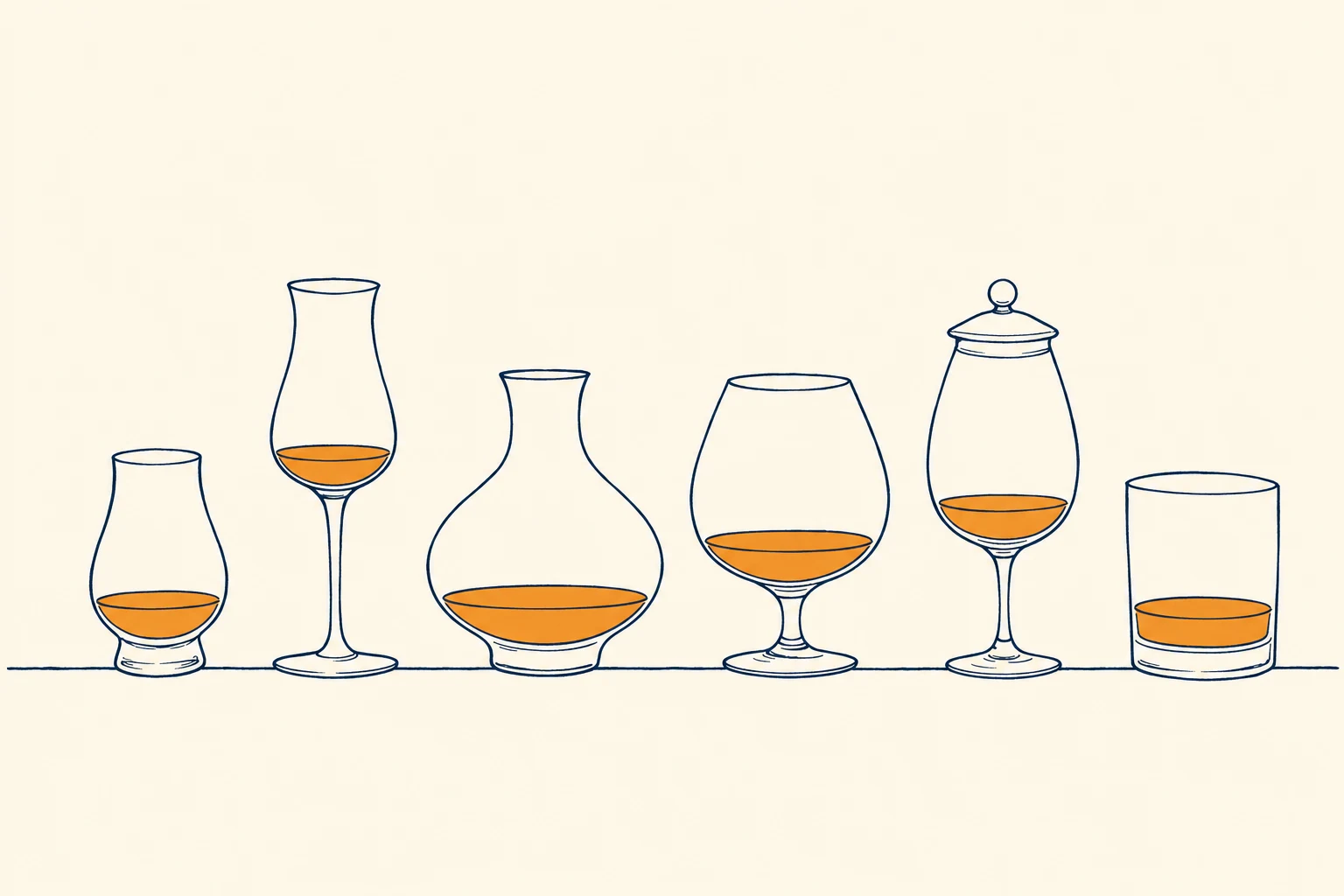
For neat tasting, use a tulip-shaped nosing glass: wide at the bottom, tapered towards the top. That can be a Glencairn, a copita, or a stemmed nosing glass. The bowl gives the rum surface area to evaporate, the narrow opening funnels the aromas to your nose. Tasting glasses are built on this principle, from the €7 Glencairn to the Riedel rum glass. Rum on ice belongs in a tumbler, a long drink like the Cuba Libre in a highball glass.
As a buying aid, sorted by budget (rough price bands, as of July 2026):
Budget
Community pick
Who it’s for
under €10
Glencairn
Beginners, everyday use, tastings with friends
€10–25
Eisch Jeunesse Rum, Luigi Bormioli Vinoteque, Spiegelau nosing
Upgraders who want crystal and a stem
€25–45
1920s Blenders Glass, Riedel Rum “Gargano × Neisson”
Enthusiasts, deliberate tasting
One-off
Hand-blown glasses (e.g. by glassblower Olaf Tappert)
Connoisseurs, a gift with a story
The tumbler, that thick-walled, cylindrical “whisky glass” from the movies, is not a tasting glass. It’s built for relaxed drinking on ice; more on that in the chapter on tumblers and cocktail glasses.
Why this guide is different
This guide rests on one thread in our forum: in May 2021, Jakob asked there, “What are the best tasting glasses to enjoy rum neat?” For this guide I went through the 227 posts by 53 participants (May 2021 to June 2026), the poll in the thread (as of July 20, 2026), a measurement series from the community, manufacturer information, and one study on glass shape. The mentions reflect opinions from the community.
Why the shape of the glass changes the taste
This is not esoterica, it’s physics. Most of what we call “taste” is smell: aroma compounds evaporate from the rum, rise, and hit your olfactory receptors as you sniff. Three properties of the glass control that process:
The surface area in the bowl. The more rum surface in contact with air, the more aroma compounds evaporate. That’s why tasting glasses are wide at the bottom.
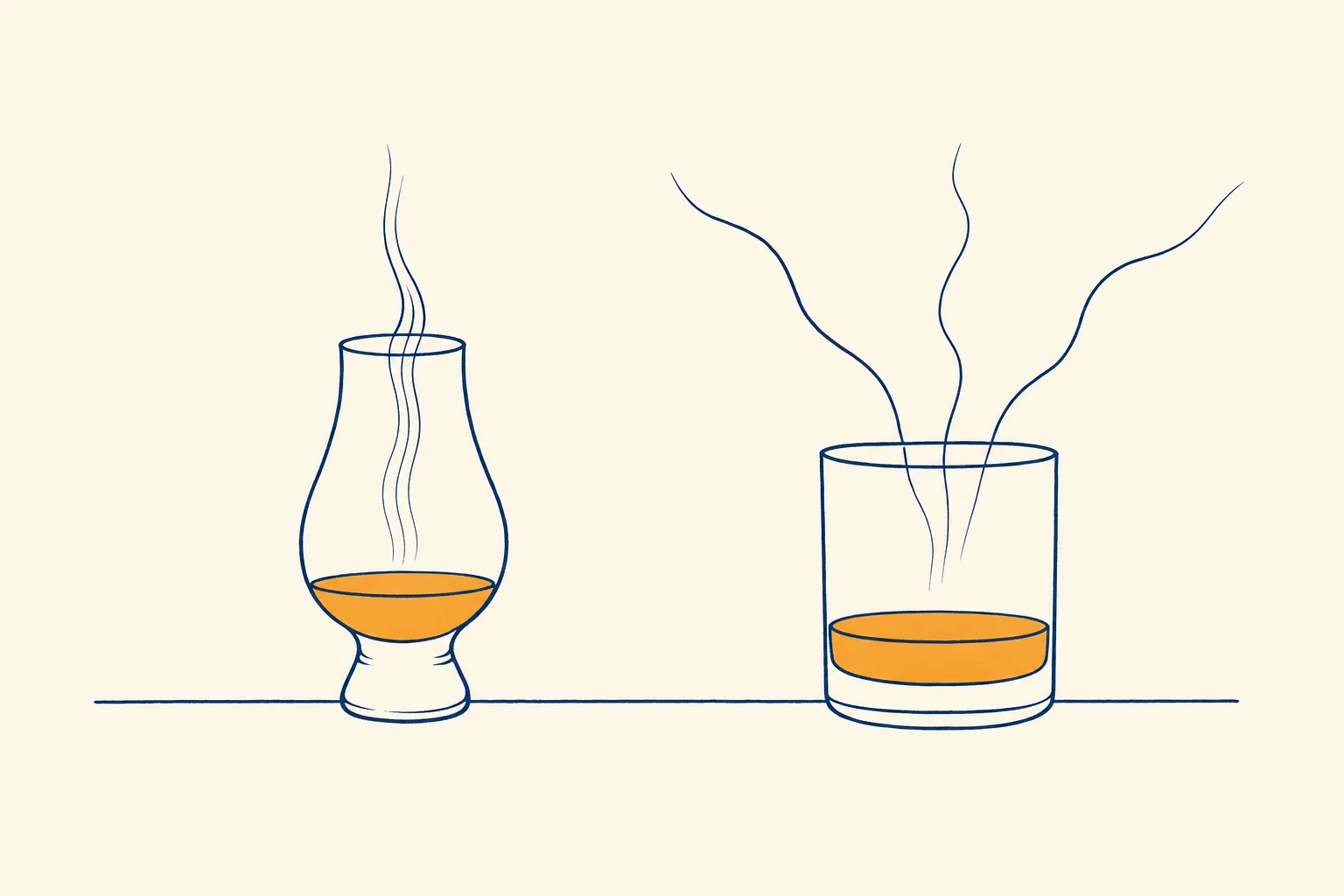
The taper (the “chimney”). The narrowing shape collects the rising aromas and concentrates them at the opening instead of letting them escape into the room.
The drinking lip. A straight or slightly flared rim distributes the rum across your tongue differently than an inward-curved one – and changes how hard the alcohol lands.
That this is measurable was shown by a study from Japan: a research team used a “sniffer-camera” to make the ethanol distribution above a wine glass visible (wine at 13 °C). The result: with the tulip shape, the alcohol forms a ring at the rim, while in the center – exactly where your nose belongs – the ethanol concentration is lower. Measured on a wine glass, but the principle holds for any tulip: the shape can spatially separate aroma from booze (Arakawa et al., Analyst, 2015).
Same rum, different journey: the tulip funnels the aromas through its chimney – in a tumbler they dissipate sideways.
Source: RumX
The community experiment: ABV has a say
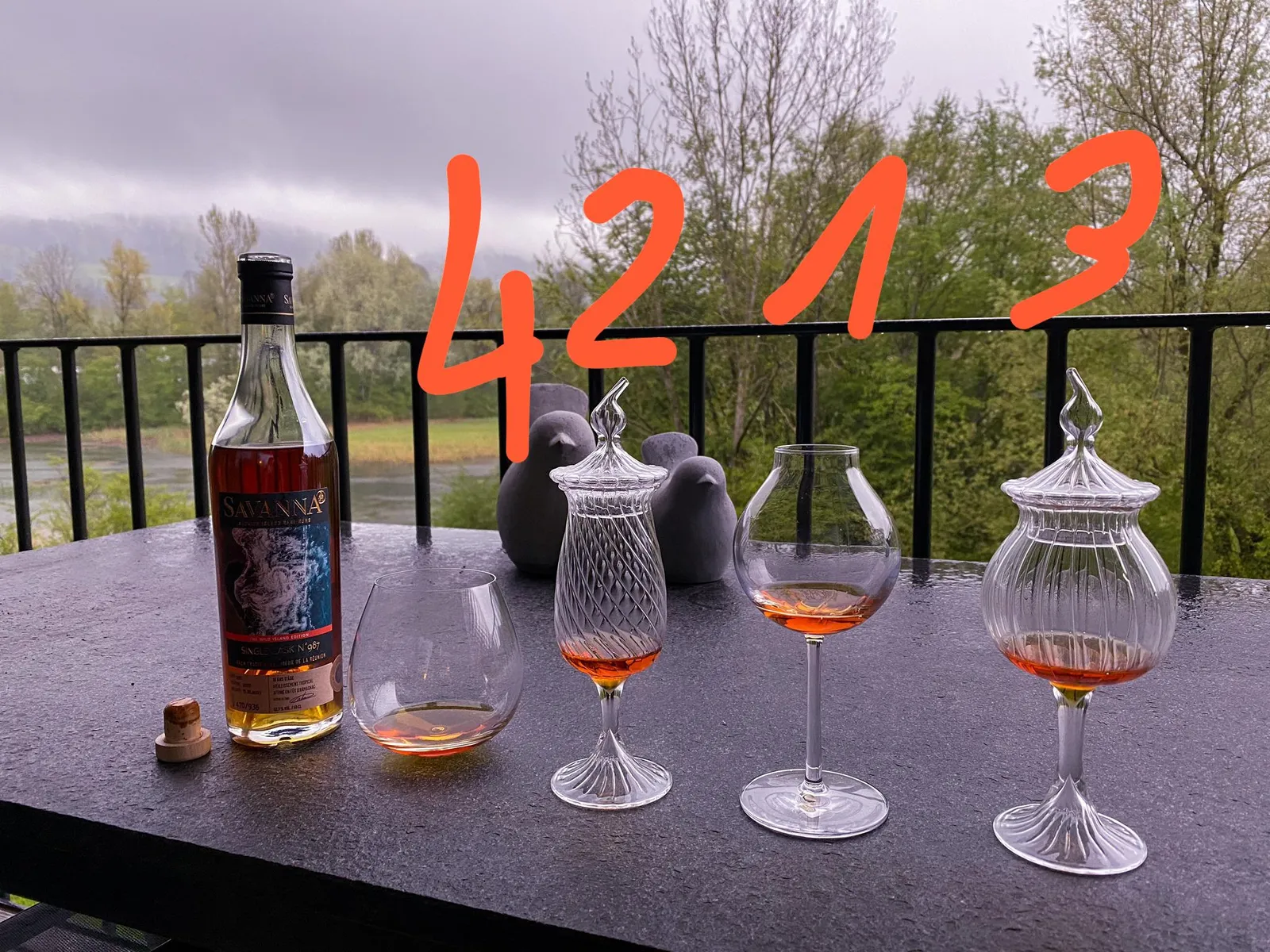
And here comes the insight this thread worked out better than any manufacturer brochure. Community member Lunulata ordered glasses with deliberately different geometries and tasted the same rum across all of them – with a clear ranking. Then he repeated the round with an Australian Beenleigh at cask strength, 78.3% ABV:
“The order came out exactly reversed. […] As alcohol increases, the 1920 becomes even more intense. With this rum it was simply too much for me.”
— Lunulata in the thread(translated)
Same rum, four geometries – Lunulata’s test round, ranking written straight onto the photo. One round later (78.3% ABV) it came out exactly reversed.
Source: Lunulata, RumX community
The entire ranking flipped. Glasses that strongly concentrate aromas make everything more intense with a 40% rum – with a cask-strength monster, they concentrate the alcohol too, until it stings. The consequence: there is no single best rum glass. There is the best glass for this rum and for your nose. (If that sounds familiar: it’s the same logic we built the RumX Match Score on – not the objectively best rum, but the best one for you.)
The glass types at a glance
Type
Shape
Ideal for
Weakness
Nosing tulip (Glencairn, copita & co.)
wide bowl, tapered top
neat tasting, the standard
high proof can sting
Onion shape (“Blenders” style)
very wide bowl, narrow opening
quiet, older, complex rums
concentrates the alcohol too
Copita / sherry glass
slim tulip on a stem
classic nosing, lab style
small opening, little “room”
Balloon / snifter / cognac glass
very wide bowl, short stem
heavy, sweet rums with lots of volume
large surface, aromas dissipate faster
Grappa / spirits flute
narrow and tall
floral, light distillates
little evaporation surface for heavy rums
Tumbler
cylindrical, thick-walled
drinking on ice, stirred cocktails
open shape bundles aromas less
Highball / long drink glass
tall, narrow, cylindrical
long drinks with lots of ice and mixer
unsuitable for nosing
Cocktail coupe
shallow bowl on a stem
shaken drinks served without ice
no room for ice
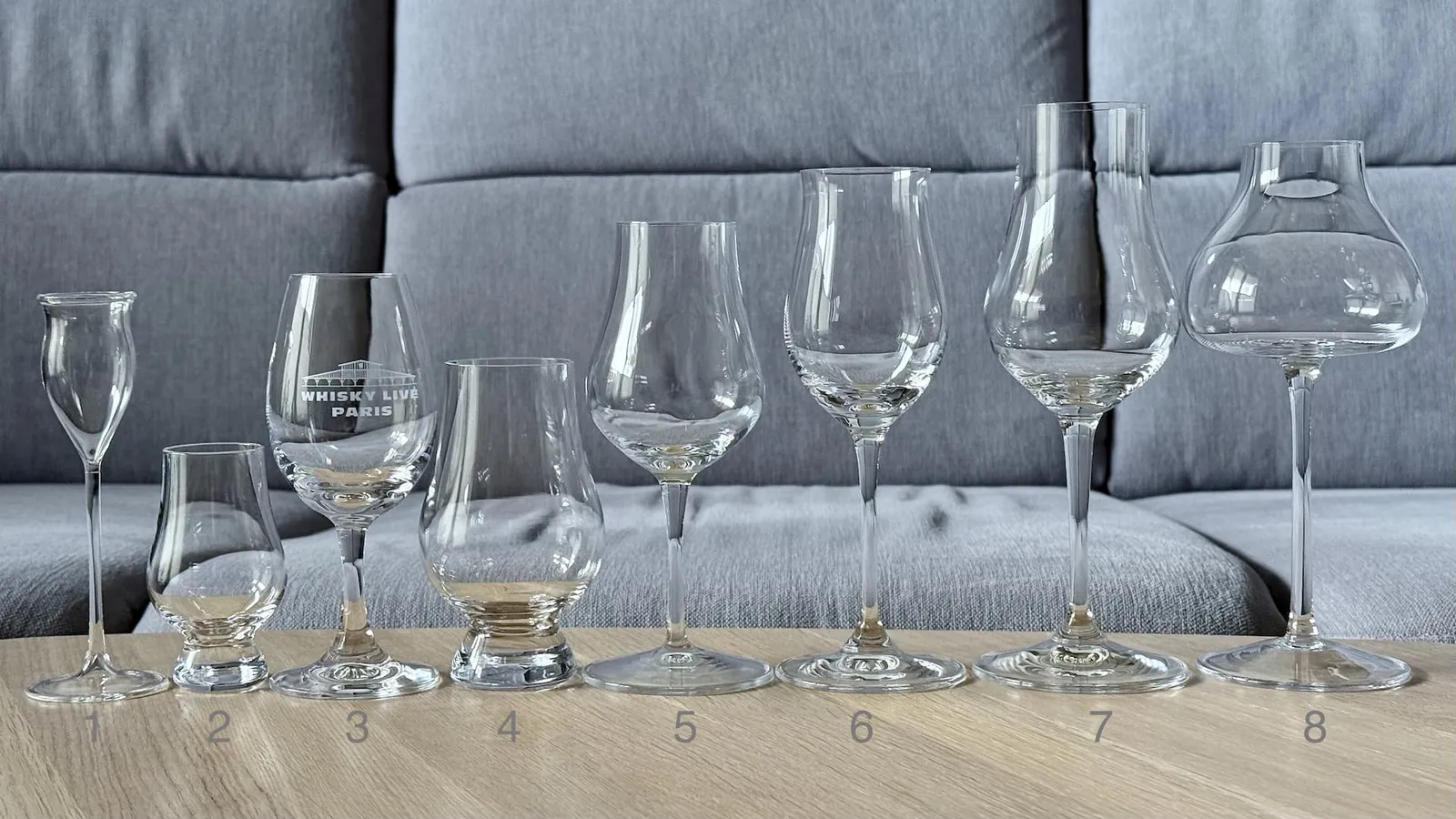
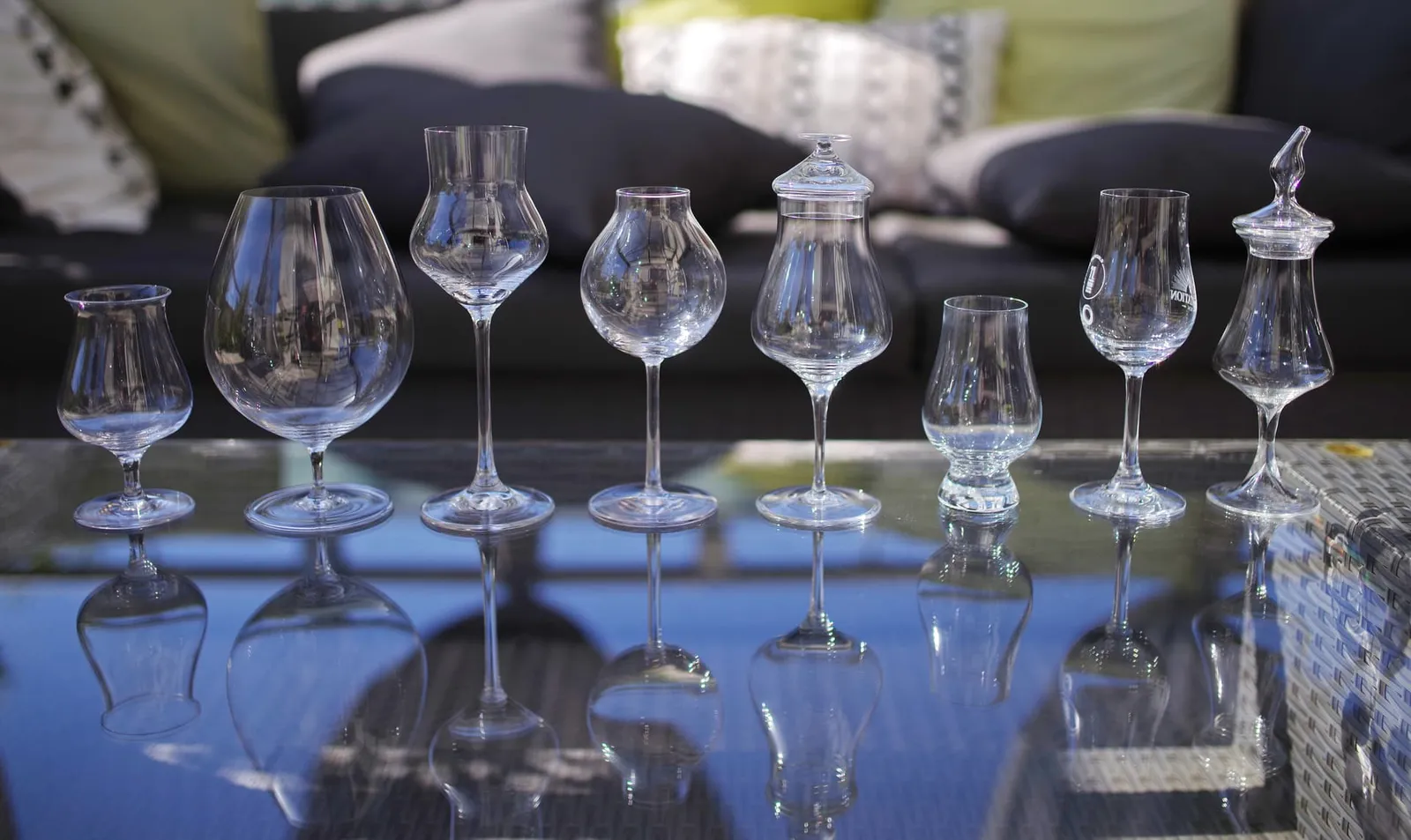
How different a “rum glass” can look: machlo’s numbered test fleet, from the slim Rochelt flute (1) to the Elephant 1948 (8).
Source: machlo, RumX community
Rum tumbler, highball, coupe: which glass for rum on ice and cocktails?
For rum on ice, use a tumbler; for long drinks, a highball glass; and for a Daiquiri, a chilled cocktail coupe. As soon as ice, juice, or cola come into play, bundling aromas no longer matters. What counts is room for ice, a stable base, and temperature.
Tumbler (Old Fashioned glass): thick-walled, with a heavy base and room for one large ice cube. The glass for rum on the rocks and for stirred drinks like the Rum Old Fashioned. The Mai Tai goes into the large version, the double Old Fashioned glass.
Highball or long drink glass: tall and narrow, for anything with lots of ice and mixer. The International Bartenders Association builds the Cuba Libre directly in a highball glass over ice (IBA recipe).
Cocktail coupe or cocktail glass: stemmed, no ice in the glass. The IBA has the Daiquiri shaken and strained into a chilled cocktail glass (IBA recipe).
The tumbler is not built for neat tasting: its straight, wide opening bundles aromas less than a tulip does. Which shape feels more pleasant also depends on the rum and its strength. In our poll (as of July 20, 2026), one of 40 participants named the tumbler as a tasting glass. If you simply want to enjoy your rum in the evening without analyzing it, the tumbler is fine. For comparing two rums or writing a tasting note, reach for the tulip.
The community ranking: what real rum nerds actually use
Anyone can count mentions – so we asked the question directly: an open poll with multiple choice is running in the thread. 40 participants have cast 97 votes – and because Tappert’s hand-blown one-offs and the Harmony 11 were initially missing as options, a follow-up poll runs in the thread (6 more votes), which we count in:
Community poll: which glasses do you taste neat from?
1920s Blenders27 votes
Glencairn21 votes
Riedel nosing13 votes
Velier/Neisson12 votes
Spiegelau10 votes
Copita/Sherry7 votes
Tappert (one-offs)5 votes
Eisch Jeunesse3 votes
Grappa glass3 votes
Harmony 11 (Rastal)1 vote
Tumbler1 vote
Forum poll in the glassware thread (as of July 20, 2026): 40 participants, multiple choice. Tappert and Harmony 11 come from the follow-up poll (6 votes).
The result confirms what five years of discussion suggest: the 1920s Blenders leads at 67%, the Glencairn is the standard behind it at 52% – and the two rum-specific nosing glasses (Riedel and Velier/Neisson) sit nearly level in midfield.
The favorites in detail
1. 1920s Blenders Glass – the community darling
By far the most discussed glass of the thread – and at 67%, also the winner of the community poll. Its distinctive onion shape is a recreation of an almost forgotten working glass that whisky blenders used to judge their casks in the 1920s – rediscovered and reissued by whisky writer Angus MacRaild together with Speciality Drinks (background at WhiskyNotes). The extremely wide bowl (225 ml capacity) gives the rum plenty of evaporation surface; the comparatively narrow opening funnels everything towards the nose.
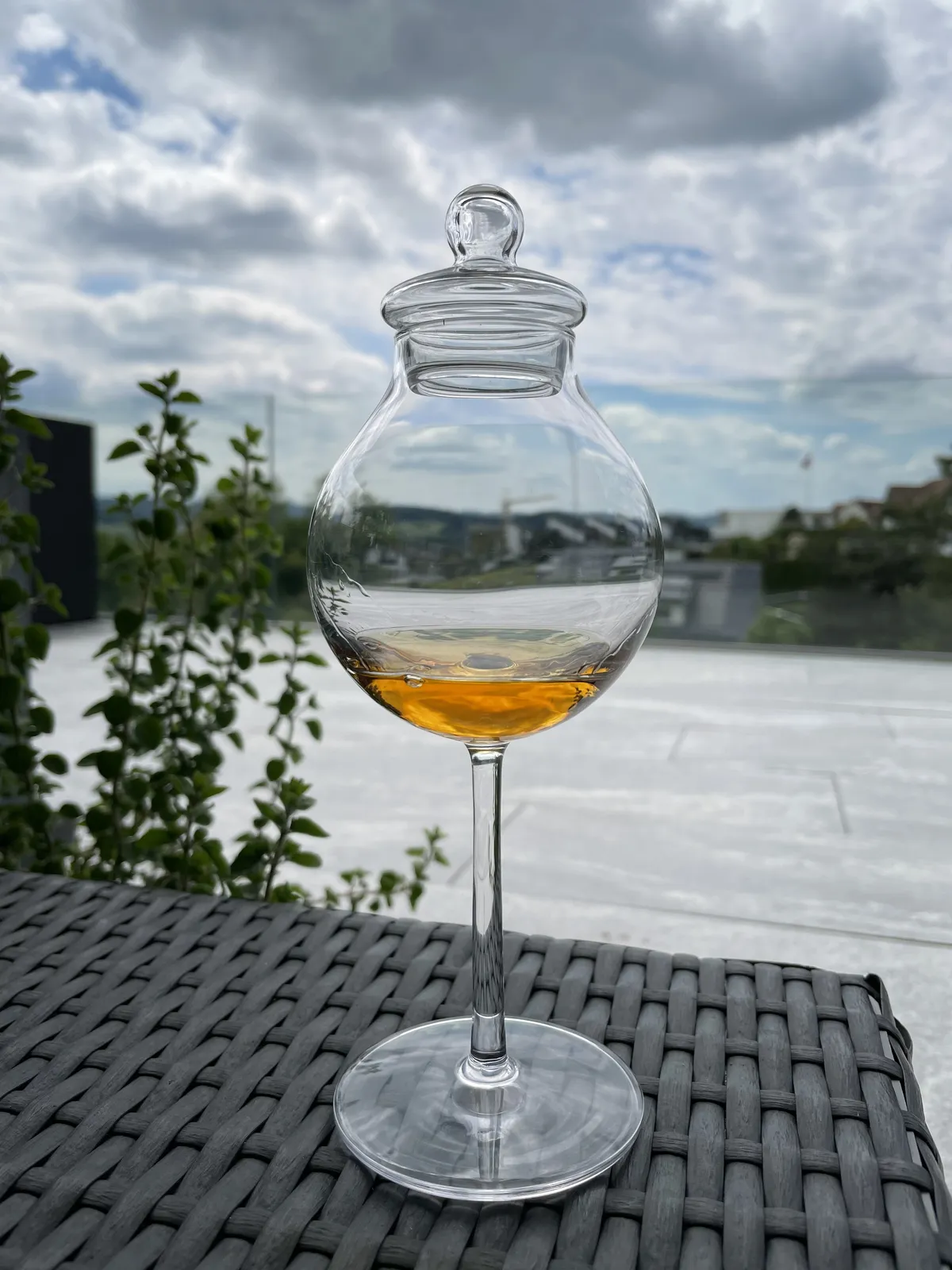
The photo that started it all in 2021: Jakob’s tasting glass with button lid from the thread’s opening post.
Source: Jakob, RumX community
“I also swear by the 1920s Blender glasses. They are quite expensive, but really worth the money!”
— mto75 in the thread(translated)
But the community also mapped out its limits cleanly: with high-proof rums, the onion shape concentrates the alcohol until it stings (see Lunulata’s experiment above). And the advertised “internal step” that supposedly “breaks up” alcohol molecules is met with healthy skepticism – after a direct comparison, mto75 files it “rather in the marketing corner”. That’s exactly the kind of honest assessment you won’t find in any manufacturer copy.
Community verdict: The reference glass for deliberate tasting at standard to medium strength. For cask strength, keep a more open glass next to it.
2. Glencairn – the indestructible standard
Launched in 2001 by Glencairn Crystal in Scotland, designed by Raymond Davidson and refined with master blenders from five major whisky houses, derived from the nosing copitas of Scottish labs (the story). Sold by the millions, robust, stemless – and at around €7 per glass, the cheapest serious option in the field.
In the thread, the Glencairn is the pragmatic backbone: sturdy enough for big tasting rounds, good enough for everything but the most ceremonial occasions. The community even has a travel version in service:
“The little sister of the Glencairn […] It looks a bit like a toy, but honestly it does a decent job for the size.”
— DevidedByZero on the “Wee Glencairn”
Community verdict: If you buy only one glass, buy this. If you need six, all the more.
3. Riedel Rum “Gargano × Neisson” – developed for rum
One of the few glasses in the field explicitly designed for rum: glassmaker Riedel developed it together with Velier legend Luca Gargano and the Martinique distillery Neisson (Riedel Rum Set, background at Velier). An egg-shaped bowl on a long stem, intended for aged and even overproof rums.
The community story around it is a lesson in itself: RumTaTa organized a group buy of twelve glasses for the thread – and then delivered an honest critique: shape and properties convince, but it remains “an industrially made glass with an ugly seam on the stem”. Anyone who has held genuinely mouth-blown glasses knows the difference. That frustration, incidentally, became the trigger for item 7 on this list.
Community verdict: A great shape with a genuine rum pedigree; opinions diverge on manufacturing quality.
4. Eisch Jeunesse Rum – crystal with a system
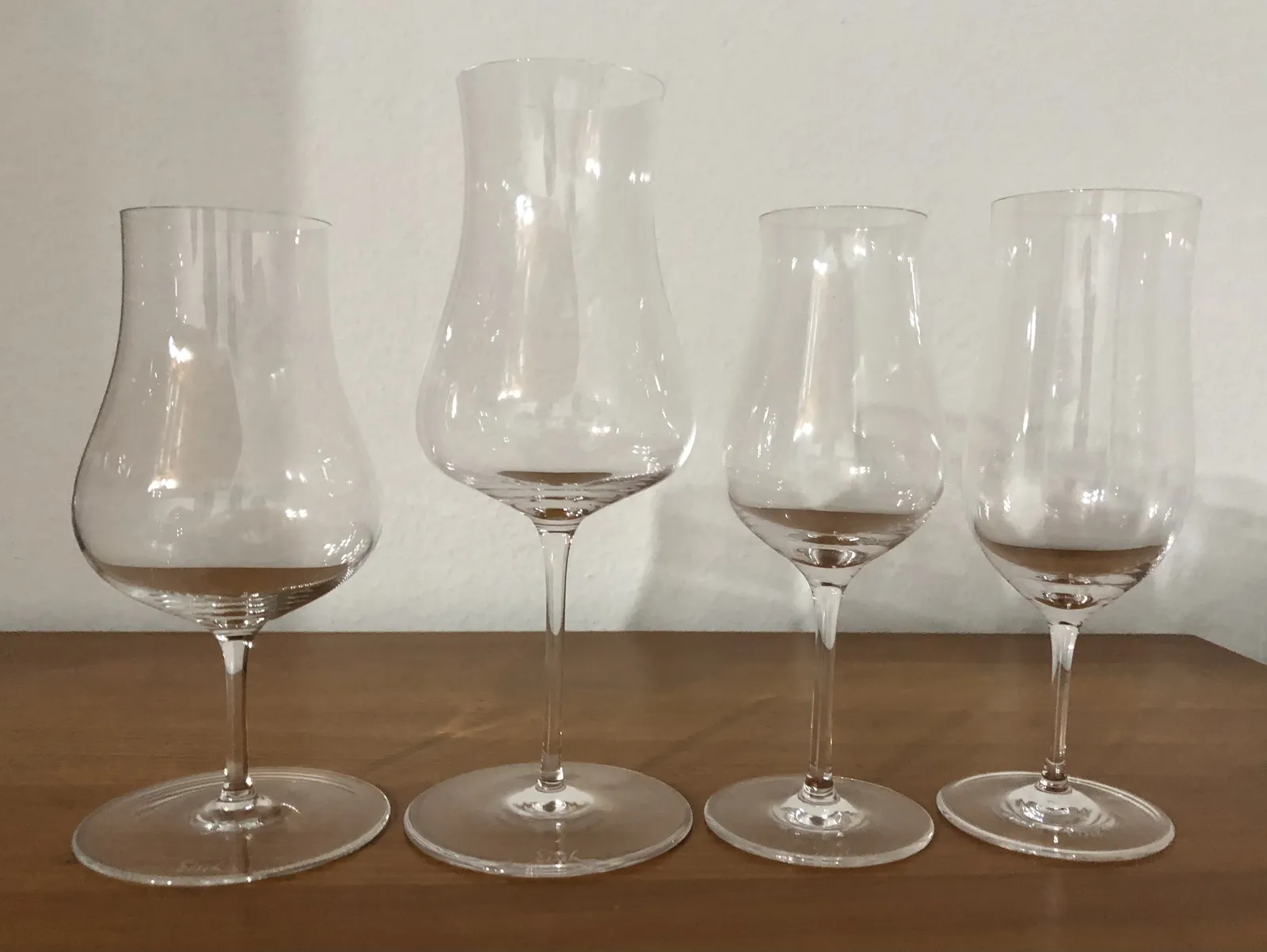
Bavarian glassworks Eisch builds a whole family of spirits glasses with its Jeunesse series, developed with spirits expert Jürgen Deibel (Eisch rum glasses). Community member VERSUS lined up and measured four Eisch shapes side by side, from the Unity whisky glass (230 ml) to the Jeunesse Rum Nosing (250 ml, 19.3 cm tall). His practical criterion is delightfully unpretentious: the stem of the big nosing glass “comfortably fits 4 sausage fingers”.
Four Eisch shapes compared directly: Unity Whisky, Jeunesse Rum Nosing, Jeunesse Malt Whisky, and Jeunesse Rum.
Source: VERSUS, RumX community
Community verdict: High-quality crystal in the mid price band with a wide range of shapes – good for anyone who wants a stem and elegance without paying Riedel prices.
5. Copita & Spiegelau – the professionals’ classics
The copita, the slim sherry tasting glass on a stem, is the old classic of labs and blending rooms – the Glencairn is ultimately its stemless granddaughter. In the thread, copitas and Spiegelau’s nosing glasses appear as solid, no-drama classics: small opening, precise nosing, no surprises. People who taste many samples in parallel (or take notes during tastings) often reach for the copita for exactly that reason.
6. The bargain hunters’ tips
Five years of thread also produce a budget wisdom no manufacturer likes to hear:
Luigi Bormioli Vinoteque snifter: costs “not even a tenth” of a Riedel – with similar properties, according to the assessment in the thread.
Retailer freebie glasses: The nosing glasses some shops add to orders are perfectly fine as everyday and backup glasses – mto75 has accumulated a whole stock that way.
Discount stores & secondhand: BananaJoe’s haul from a clearance store (photo evidence) is a reminder that good glass shapes can sit on a shelf for next to nothing.
And perhaps the thread’s most grounding note: good rum will, if need be, taste good out of a water glass. The glass extracts the maximum – it doesn’t rescue a bad rum and doesn’t ruin a great one.
7. The one-off: mouth-blown glasses by Olaf Tappert
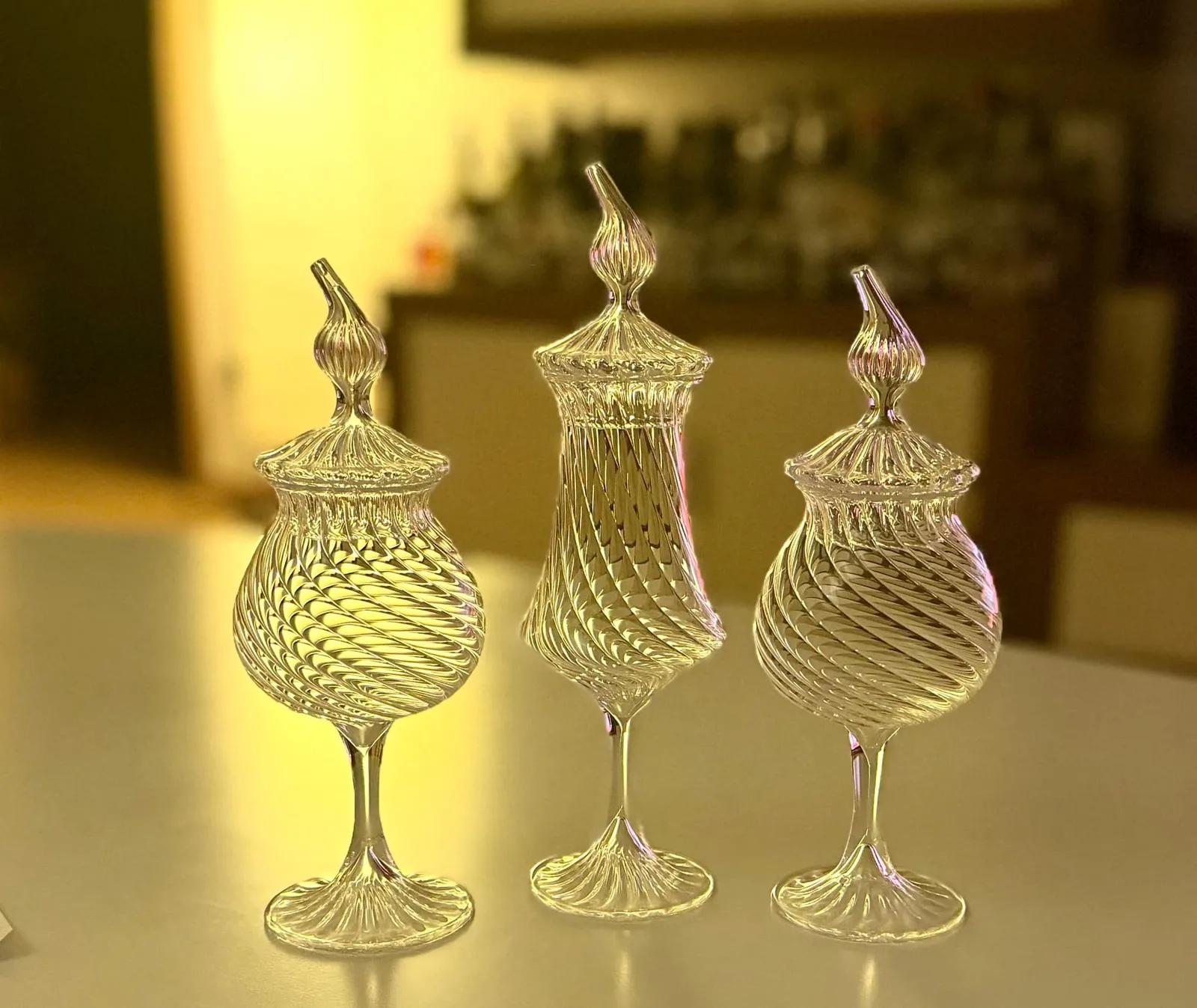
The most beautiful story of the thread. Searching for a perfect glass without an industrial seam, RumTaTa contacted around ten glassblowers – seven declined. The community struck gold with Olaf Tappert: a paramedic by profession, whisky lover, taught glassblowing by his grandfather, he crafts every glass by hand in his own workshop. Fuwi had his first glasses made right there in the workshop – and in Fuwi and Thunderbird’s direct comparison, Tappert’s “Riffelglas” (ribbed glass) even won against the Blenders favorite when opening a fresh rum:
“Olaf Tappert’s glass really convinces with its wider opening and the small volume needed in the bowl. Clear buy recommendation!”
— Fuwi in the thread(translated)
Three mouth-blown one-offs by Olaf Tappert – Thunderbird’s surprise after the RumX meetup, October 2025.
Source: Thunderbird, RumX community
Community verdict: Not a catalog product but a one-off with a story – and proof that this scene’s most exciting discoveries don’t come from wholesale.
Measurements: RumTaTa, RumX community (April 2024). Inner surface is a rough calculation. The diameter is the widest point of the glass, not the opening: for the Glencairn, retailers state 4.6 cm at the rim and 6.7 cm at the widest point (Lindores Abbey).
The measured fleet: eight candidates from RumTaTa’s measurement series – from the whisky.de glass to the Tappert Companach.
Source: RumTaTa, RumX community
Two things you can read straight off: the cognac balloon, at 884 ml capacity and 11.2 cm in diameter, is a different tool from the other glasses. In RumTaTa’s nosing it delivered the most intense aromas, but was almost mute after about 45 minutes. And the hand-blown Tappert glass weighs 65 g, about half as much as the other seven glasses (100 to 142 g), a difference you feel in your hand at once.
Practical tips: how to get more out of any glass
Pour 2 cl. The bowl needs headspace to work – a glass filled to the brim tastes worse than a modest pour. 2 cl is our standard recommendation, in every glass from the mini Glencairn to the Blenders.
A clean, dry glass per rum. For direct comparisons, identical, clean, and dry glasses are practical. If you reuse a glass, rinse it thoroughly and dry it, so that neither water nor the previous rum stays in the glass.
Cover the glass. Button lids or simply a watch glass (about 6 cm diameter fits most nosing glasses) let the rum breathe without the aromas escaping – the standard trick at tastings with multiple glasses.
Give it time. Freshly opened and high-proof rums in particular need a few minutes in the glass. Nose first, then wait, then judge.
At cask strength: wider and lower. High alcohol calls for a wider opening, more distance to the nose – or simply a few drops of water.
On the road: go mini. The “Wee Glencairn” is the community’s proven travel companion for holidays and sample swaps.
Hand-wash, then smell-check. Rinse-aid residue smells. The nerds’ test: sniff the empty, dry glass before any rum goes in. Glencairn and Riedel do state their glasses are dishwasher safe (Glencairn); if the glass smells afterwards, rinse it with hot, clear water.
Travel size: the “Wee Glencairn” with 2 cl next to the standard – the community’s proven holiday trick.
Source: DevidedByZero, RumX community
Frequently asked questions about rum glasses
A whisky nosing glass will do. Almost all “rum glasses” are nosing glasses that work just as well for whisky; the Glencairn and the 1920s Blenders even come from the whisky world. Only a few glasses were designed for rum, such as the Riedel “Gargano × Neisson” for aged, sometimes overproof rums and the Eisch Jeunesse Rum. They follow the same tulip principle.
Like a tulip or an onion: wide bowl, narrowing opening, often a short stem or foot. Capacity is usually 160–250 ml, but you only pour 2 cl.
No. The consensus from five years of community discussion: a Glencairn for around €7 delivers most of the experience, and good rum will taste good out of a water glass if it has to. More expensive glasses refine – they don’t decide.
For the aromas, the bowl matters, not the stem. With a stem you don’t hold the glass by the bowl, so it stays free of fingerprints and you see the rum clearly. Without a stem a glass is lower, more stable, and easier to store: the Glencairn measures 11.5 cm, the long-stemmed Riedel rum glass 21.3 cm (measurements from our forum). Stemless for big rounds and travel, stemmed if you like it for deliberate tasting at home.
For everyday use, two identical nosing glasses are enough, so you can compare two rums side by side. For a tasting, one glass per rum and person is practical, because direct comparisons need identical, clean, and dry glasses. If you reuse a glass, rinse it thoroughly and dry it. What matters in a set is the same shape for every rum in a comparison, since the shape of the glass can change the result. A set of six Glencairns is the affordable way in. You only need tumblers for rum on ice and cocktails.
Not for the aroma; the shape decides that. Crystal is also no sign of an expensive glass: Glencairn states lead-free crystal for its standard glass, and Riedel and Eisch also name crystal for their rum glasses (manufacturer information). The difference you feel in your hand comes from wall thickness and weight: in the measurement series from our forum, the mouth-blown Tappert glass weighs 65 g, the other seven glasses 100 to 142 g.
Join the discussion – in the thread this guide grew from
This guide is a snapshot, not a final edition – the thread lives on, and the next surprise (a RumX glass by Olaf Tappert? 👀) is probably only a few posts away. Which glass is missing here? What do you taste with? Join the discussion right below – the comments are live-connected to our forum:
Cheers,
Oliver(founder, RumX)
This guide is based on an analysis of 227 posts by the RumX community (May 2021 – June 2026), the thread poll (40 participants, multiple choice, as of July 20, 2026), manufacturer information, and the study cited. No affiliate links, no paid placements. Price bands are indicative. Translated quotes are marked. Community photos come from the linked forum thread, with the author credited below each image; illustrations: RumX.
Rum is a spirit made from molasses, sugarcane syrup or sugarcane juice, bottled at 37.5% ABV or more in the EU. How it is made, and how it differs from rhum agricole, cachaça and rum-based spirit drinks.