
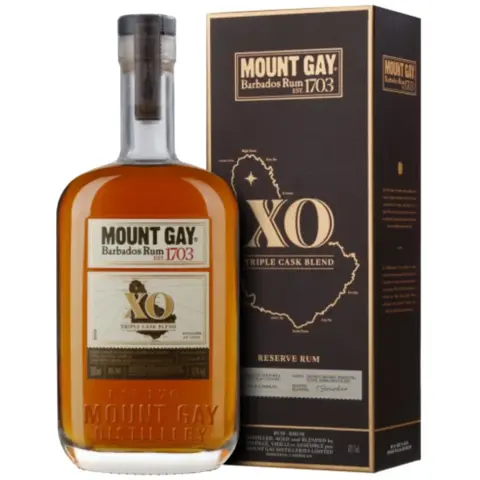
Mount Gay XO - Triple Cask Blend
7.8/10 (468 reviews)
Vanilla · Caramel · Oak
What the RumX community records when tasting, five bottles for a first comparison and how samples let you get to know different rums in small amounts
Tasting rum means smelling and tasting slowly and recording what you notice. You don’t need specialist vocabulary or expensive equipment for it. This guide shows you the sequence and draws on what the RumX community actually notes when tasting: aromas, sliders and texts from 125,379 tastings with aroma tags. On top of that come five bottles for your first tasting at home and the way samples let you get to know different rums in small amounts.
You pour 2 cl (20 ml) into a nosing glass, give the rum time, nose it, take a small first sip to prepare the palate and judge from the second sip on. You learn the most when you taste two to five clearly different rums side by side.
These five bottles differ so clearly in the aromas members tick that you will find the differences without practice. The order goes from lower to higher strength, and the sweet rum comes last.
| Order | Bottle | Style | Typical aromas according to the community |
|---|---|---|---|
| 1 | Mount Gay XO | Barbados, 43 % ABV | Vanilla, caramel, wood, oak |
| 2 | El Dorado 15 | Guyana, 43 % ABV | Wood, vanilla, spice, burnt sugar |
| 3 | Rhum J.M XO | Rhum agricole from Martinique, 45 % ABV | Wood, spice, pepper, sugarcane |
| 4 | Hampden 8 | Jamaica, 46 % ABV | Banana, ester, tropical fruits, pineapple |
| 5 | Diplomático Reserva Exclusiva | Sweet rum from Venezuela, 40 % ABV | Sweetness, caramel, vanilla |
Why these five in particular is explained in the chapter Five bottles. If you would rather first work out what makes a good bottle, the guide Buying rum: how to spot quality will help.
In four stages: appearance, nose, palate, finish. This is also how the RumX app takes you through a tasting. What matters before and in between comes from our forum and from rum experts on YouTube. Where something is only practice and not a documented rule, we say so.
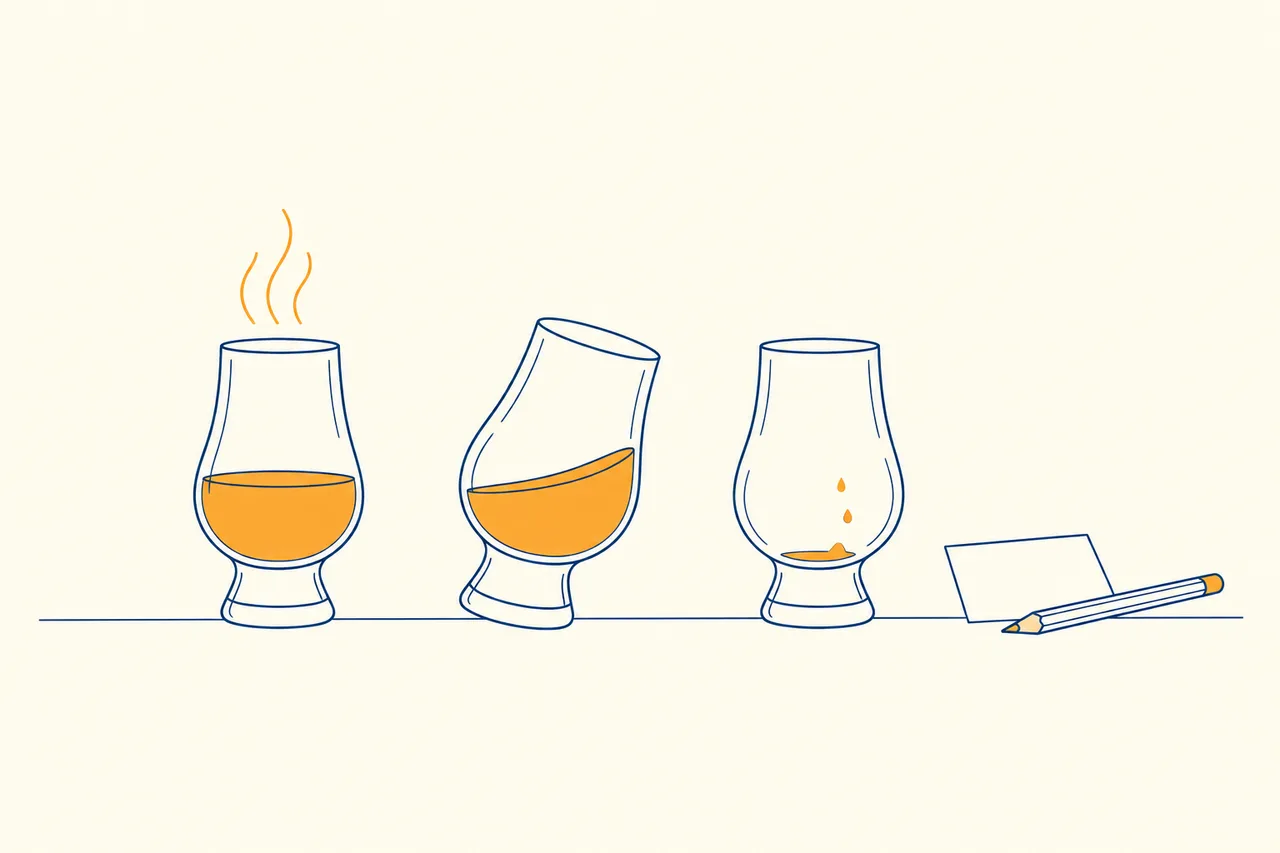
Use the same tulip-shaped glass for every rum and pour 2 cl. Why the shape matters and how to cover glasses and keep them clean is in the guide to rum glasses. On the amount: the Rum-Schnacker pours 2 cl in his tastings. Two members write in the forum that 1 cl is now enough for them.
Then give the rum a few minutes in the glass. Three members describe in the forum topic on tasting that they wait considerably longer: at least 30 minutes, or between 20 minutes and two hours depending on the rum. The Rum-Schnacker also names 30 minutes. For high-strength rums, one member explicitly advises a good half hour.
Swirl the glass gently and watch how the rum runs down the side. In the app this is where you record colour and consistency. The colour doesn’t tell you much: under the EU Spirits Regulation, caramel colouring may be added to rum to adjust its colour. So a dark rum is not automatically an old one.
Approach the glass from above and in small steps. The Rum-Schnacker advises against sticking your nose deep into the glass, Rumperium against sniffing endlessly. The Rum-Schnacker’s reason is the alcohol that sits directly above the surface and smells of methylated spirit. Step back in between and come back again.
At this point the app asks “What exactly do you smell?”. If nothing comes to mind, do as the Rum-Schnacker does and ask more narrowly: which fruit? Vanilla? Caramel? Chocolate? The community’s most common aromas make a ready-made list of questions.
Take a small sip first and don’t judge it. The Rum-Schnacker calls this the “Vorschluck”, a preparatory sip: judging only starts with the second. One member in the forum proceeds in three sips, two to warm up, and the third counts. Two members describe spreading the rum around the whole mouth before they swallow.
Whether you stay neat or add a few drops of water to the glass, and which temperature fits, is covered in the guide How do you drink rum?.
Pay attention to what stays after swallowing, and for how long. In the app you choose short, medium or long. Among the tastings with this entry, just under half say “medium” and a third “long”. The finish brings up impressions that hardly anyone names on the nose: dry, bitter, warm. Take your time; one member writes that for him the impression sometimes still changes minutes later.
Write three lines and give your score before you move on to the next glass. The Rum-Schnacker advises beginners not to look for every nuance but only to write down the differences between the glasses: fruitier, woodier, sweeter. In the RumX app you tap aromas instead of searching for words. More on that under tasting notes in the app.
The experts don’t agree on this. Rumperium recommends a sip of water between two rums. The Rum-Schnacker said the same in 2023; in a video from May 2026 he does without it: without water, he says, he recognises the differences better. His own rule on it is the most useful one: do it the same way with every glass.
Wood, vanilla and caramel. In the RumX community, “Woody” appears in almost every second tasting with tags, “Vanilla” in four out of ten. Fruit, sweetness and spice follow.
Share of tastings with aroma tags in which the aroma appears on the nose, palate or finish. As of 27 November 2026, across all rums.
Use these ten as a list of questions for your first tasting. If you find none of the ten in a rum, that is not a mistake on your part but a sign of an unusual style.
More interesting is where an aroma shows up. When ticking, the community separates nose, palate and finish, and the three stages look different:
| Aroma | Nose | Palate | Finish |
|---|---|---|---|
| Vanilla | 36 % | 30 % | 16 % |
| Banana | 16 % | 11 % | 5 % |
| Glue | 10 % | 4 % | 2 % |
| Sweet | 10 % | 19 % | 10 % |
| Spicy | 10 % | 19 % | 13 % |
| Peppery | 3 % | 10 % | 7 % |
| Woody | 36 % | 42 % | 38 % |
| Dry | 1 % | 9 % | 13 % |
| Bitter | under 1 % | 6 % | 9 % |
Share of tastings in which the aroma is ticked in the respective stage. The basis is the tastings with tags in all three stages, as of 27 November 2026.
This tells you what you can look out for at which stage. You find fruit, vanilla and the solvent notes of powerful rums mainly on the nose. Sweetness, spice and heat only show in the mouth. Wood stays through all three stages, and the finish adds dryness and bitterness.
Yes, and so clearly that origin is the best way to organise a tasting. In the RumX community, “Ester” appears nine times as often for rum from Jamaica as for all other rums, “Coconut” six times as often for Barbados and “Sugarcane” seven times as often for rhum agricole.
| Style | Most common aromas | Far more often than for other rums |
|---|---|---|
| Jamaica | Tropical fruits 57 %, Ester 56 %, Woody 46 %, Pineapple 45 % | Funky 12 times, Ester 9 times, Pineapple 6 times |
| Barbados | Vanilla 63 %, Woody 51 %, Caramel 47 %, Coconut 41 % | Coconut 6 times, Oak and Raisin just under 2 times |
| Rhum agricole from Martinique and Guadeloupe | Woody 54 %, Sugarcane 43 %, Vanilla 38 %, Vegetal 28 % | Sugarcane 7 times, Grass 5 times, Vegetal 4 times |
| Guyana | Woody 64 %, Dried fruit 39 %, Caramel 36 %, Roasted 36 % | Prunes 6 times, Licorice 4 times, Anise 4.5 times |
| Trinidad | Woody 57 %, Vanilla 38 %, Minty 36 %, Tar 36 % | Tar 31 times, Rubber 14 times, Menthol 8 times |
| Sweet rum | Vanilla 58 %, Sweet 55 %, Caramel 51 % | Sweet 2.5 times, Sugar 5 times, Mild 3 times |
Share of the tastings with tags for each style, between 7,171 (sweet rum) and 23,026 (Jamaica) tastings. The factor compares with all other rums. As of 27 November 2026.
The app’s sliders confirm the picture. On the scale from 1 to 5, members place sweet rum at 3.0 on average for “Sweetness” and rum from Jamaica at 2.0. For “Fruit”, Jamaica is clearly ahead. Guyana is above the average of all rums for “Woody”, and rhum agricole for “Floral”.
For your tasting this means: take one bottle from each corner and you will be working with differences that are large enough. How the styles come about is explained in the overview of types of rum. You will find cask-aged bottles under aged rum and unaged ones under white rum.
No, they name the same aromas, just fewer of them. When they tick aromas, beginners on RumX typically tick five per tasting, experienced members ten. If you compare both groups on the same 214 bottles, the gap remains: a good six against just under ten.
There is not a single aroma that beginners name appreciably more often than experienced members. The other way round, there is a clear list. On the same bottles, these aromas appear about twice as often or more among experienced members:
That is the good news for your first tasting: you are not tasting wrongly, you just don’t have enough comparisons yet. Most tastings on RumX consist of little anyway. Just under half contain only a score, 39 % carry aroma tags, 36 % a text. Among beginners, one tasting in four carries tags, among experienced members a good four in ten.
On scores, the two groups are close together more often than you might think. Beginners and experienced members rate four of the five bottles from the suggestion above practically the same. They part ways on the sweet rum: beginners put the Diplomático Reserva Exclusiva at 7.5, experienced members at 7.0. This video with the community’s data shows what is behind that (the video is in German).
Five bottles from five styles, each stocked by several partner shops and each below 50 % ABV: Mount Gay XO, El Dorado 15, Rhum J.M XO, Hampden 8 and Diplomático Reserva Exclusiva. For each there are more than 100 tastings with aroma tags on RumX, and their profiles differ clearly.
| Bottle | Tastings with tags | Most common aromas | Stands out for |
|---|---|---|---|
| Mount Gay XO | 174 | Vanilla 74 %, Caramel 62 %, Woody 51 %, Oak 45 % | Dark chocolate 43 %, Coconut 34 % |
| El Dorado 15 | 104 | Woody 76 %, Vanilla 68 %, Spice 56 %, Caramel 48 % | Burnt sugar 42 %, Roasted 39 % |
| Rhum J.M XO | 114 | Woody 65 %, Spice 60 %, Vanilla 60 %, Peppery 57 % | Sugarcane 42 %, Grass 25 % |
| Hampden 8 | 112 | Banana 77 %, Ester 64 %, Tropical fruits 63 %, Woody 61 % | Pineapple 52 %, Varnish 33 % |
| Diplomático Reserva Exclusiva | 307 | Sweet 68 %, Caramel 67 %, Vanilla 64 % | Sugar 28 %, Mild 26 % |
Share of the tastings with tags for each bottle, as of 27 November 2026. The selection is an editorial suggestion based on these data.
Five styles for a first tasting, in tasting order
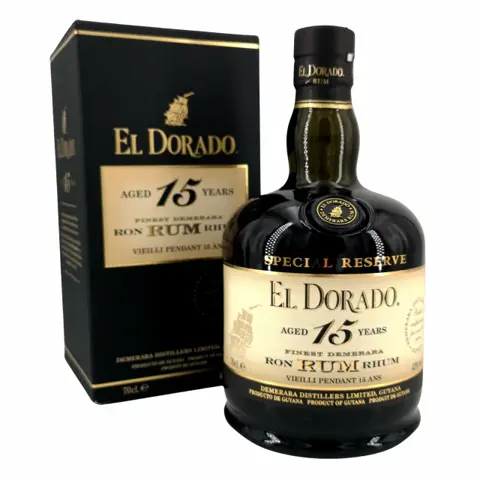
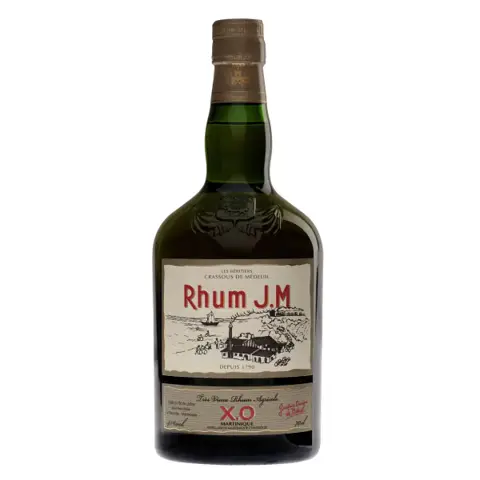
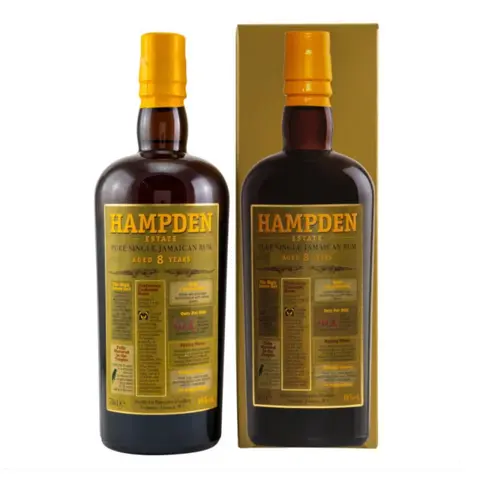
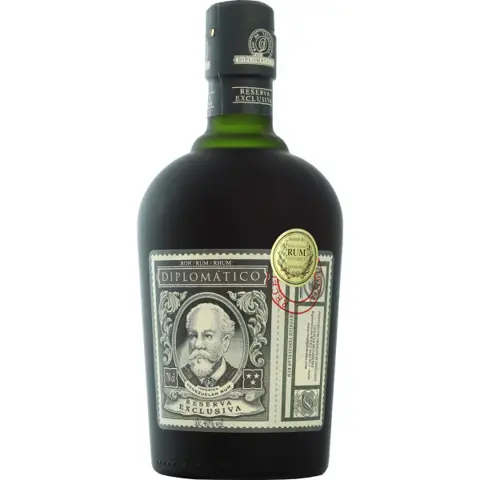
Of all of them, the El Dorado 15 is closest to the Mount Gay XO in its tags; this is where you practise the fine differences. For the Hampden 8, one member in three ticks “Varnish”: nose this one from a little further away.
The order follows two considerations. The strength rises from 43 to 46 % ABV, so that the more powerful rum doesn’t drown out the quieter one. And the sweet rum comes last: the Rum-Schnacker shows in an experiment that a dry rum seems harsh straight after a sweetened one, and in his round of five he puts a sweetened rum at the end as dessert. It is not a fixed rule. The same expert deliberately builds his rounds in alternation so that the differences stand out more quickly.
Three variants if five are too many for you or one style is too wild:
The milder alternative from Jamaica
That the selection matches practice is shown by a forum topic from November 2026 (in German): someone who has so far drunk sweet rums asks about the next step. Members there name Mount Gay XO, El Dorado 15 and Hampden 8, among others, and advise ordering samples first.
If you want more after the first evening: the top rums for beginners and the best sipping rums supply the next candidates, and the list The rums connoisseurs love most shows where the journey can lead. The Rum Finder works out which style suits you in a few questions.
Yes: with small amounts you get to know different rums without buying whole bottles, and experienced rum lovers use them far more often than beginners. On RumX, almost one tasting in five by experienced members is recorded in the app as a sample, among beginners about one in thirty.
Three routes lead to small amounts:
RumX sells nothing from its own stock, and the partner shops’ price comparison contains almost only full bottles; tasting sets are missing (as of 27 November 2026). So we can’t recommend a specific set with data. Here is what you can check before buying:
In a forum poll on sample size, 36 of 52 participants voted for 5 cl, 8 for 3 cl and 5 for 2 cl.
A tasting set also works as a gift if you don’t know the person’s taste. That is what Rumtastisch says in a video about a set of five. More ideas are in the guide Giving rum as a gift.
Samples help at the top end too. In the Guyana guide on YouTube (in German), RumX founder Oliver Gerhardt says of the legendary bottlings, for which members have in some cases paid four-figure prices: there are samples, bottle splits and tastings, and that is how he was able to try most of them.
Someone else pours and numbers the glasses, you taste and take notes, and only then are the bottles revealed. That is all it takes. The point: you judge without knowing the label, price and reputation of the bottle.
On RumX, tasting is almost always open. Only 395 tastings by 38 members carry the “blind” flag, which has existed in the app since 2024 (as of 27 November 2026). So the scores on the rum pages are verdicts from people who knew what was in the glass. With RX+, the app hides which rum is in the glass on request until you reveal it.
Three things make a blind round at home better:
A forum topic from 2024 (mostly in German) shows what this looks like in the community: a member picked nine bottles with few ratings from his collection and offered them as a set of 5 cl each, as a blind tasting with a guessing game. Nicolas Kröger says he tests supermarket spirits blind as a matter of principle.
Time in the glass, nosing from a distance and tasting together are recommended by both the Rum-Schnacker and Rumperium; on water between rums and on the order, opinions differ. The table collects the statements from ten videos by four German channels, which also include Rumtastisch and Nicolas Kröger. The videos are in German. The statements are paraphrased, and each link jumps to the relevant moment in the video.
| Topic | Expert | Statement | Video |
|---|---|---|---|
| Amount | Rum-Schnacker, 2023 | Pours 2 cl per rum in his live tastings | watch |
| Time and nose | Rum-Schnacker, 2024 | Pour, wait 30 minutes, then approach with the nose from above | watch |
| Time | Rumperium, 2021 | Compares a fresh glass with one that has stood longer: the rum should breathe | watch |
| Nose | Rumperium, 2021 | Don’t sniff at the glass endlessly, step back in between | watch |
| Colour | Rumperium, 2021 | The colour can be adjusted with caramel colouring | watch |
| First sip | Rum-Schnacker, 2023 | He ignores the first sip as a preparatory sip; judging starts with the second | watch |
| Finding aromas | Rum-Schnacker, 2023 | Ask specifically: which fruit? Vanilla? Caramel? Chocolate? | watch |
| Water in between | Rum-Schnacker, 2023 | Water between rums resets the tongue to zero; he says one should always do that | watch |
| Water in between | Rum-Schnacker, 2026 | No water and no rinsing: without water, he says, you recognise differences better; anyone who prefers it otherwise should do it otherwise | watch |
| Water in between | Rumperium, 2021 | With several rums, a sip of water between the glasses helps | watch |
| Water in between | Rum-Schnacker, 2026 | With or without water: what matters, he says, is always doing it the same way | watch |
| Beforehand | Rum-Schnacker, 2026 | After garlic or a coffee, a rum can no longer be judged sensibly | watch |
| Comparing | Rum-Schnacker, 2026 | Put a familiar rum alongside as an anchor and taste in alternation | watch |
| Taking notes | Rum-Schnacker, 2026 | At the start, don’t look for every nuance, just write down the differences | watch |
| Form on the day | Rum-Schnacker, 2026 | Don’t give a rum a final verdict after a single sip | watch |
| Order | Rum-Schnacker, 2026 | Builds tastings not from light to heavy but in alternation | watch |
| Order | Rum-Schnacker, 2026 | In his round of five, puts a sweetened rum at the end as dessert | watch |
| Order | Rum-Schnacker, 2022 | The same sweetened rum suddenly seems sticky after a dry one | watch |
| Selection | Rum-Schnacker, 2026 | For people with little experience, leaves out the extreme Jamaicans so as not to overwhelm anyone | watch |
| Selection | Rum-Schnacker, 2023 | He calls the earlier Hampden without an age statement a masterpiece, but not one for the start of the rum journey; he describes today’s eight-year-old as softer | watch |
| Together | Rum-Schnacker, 2024 | Especially at the start, taste with others rather than alone | watch |
| Together | Rumperium, 2021 | Taste with friends, everyone brings a bottle | watch |
| Tasting set | Rumtastisch, 2019 | A tasting set works as a gift if you don’t know the person’s taste | watch |
| Blind | Nicolas Kröger, 2022 | Tests supermarket spirits blind as a matter of principle | watch |
The point on selection also concerns the suggestion above. The Rum-Schnacker would not put a Hampden at the start of a rum journey; he said that in 2023 about the predecessor bottling. We included the Hampden 8 because of its large distance in the tags, and that is why we name the milder alternative.
Since 2023 the forum has had a topic on how members taste: how long they wait, how many sips they take, what they note down. The posts are in English and German. Add what works for you.
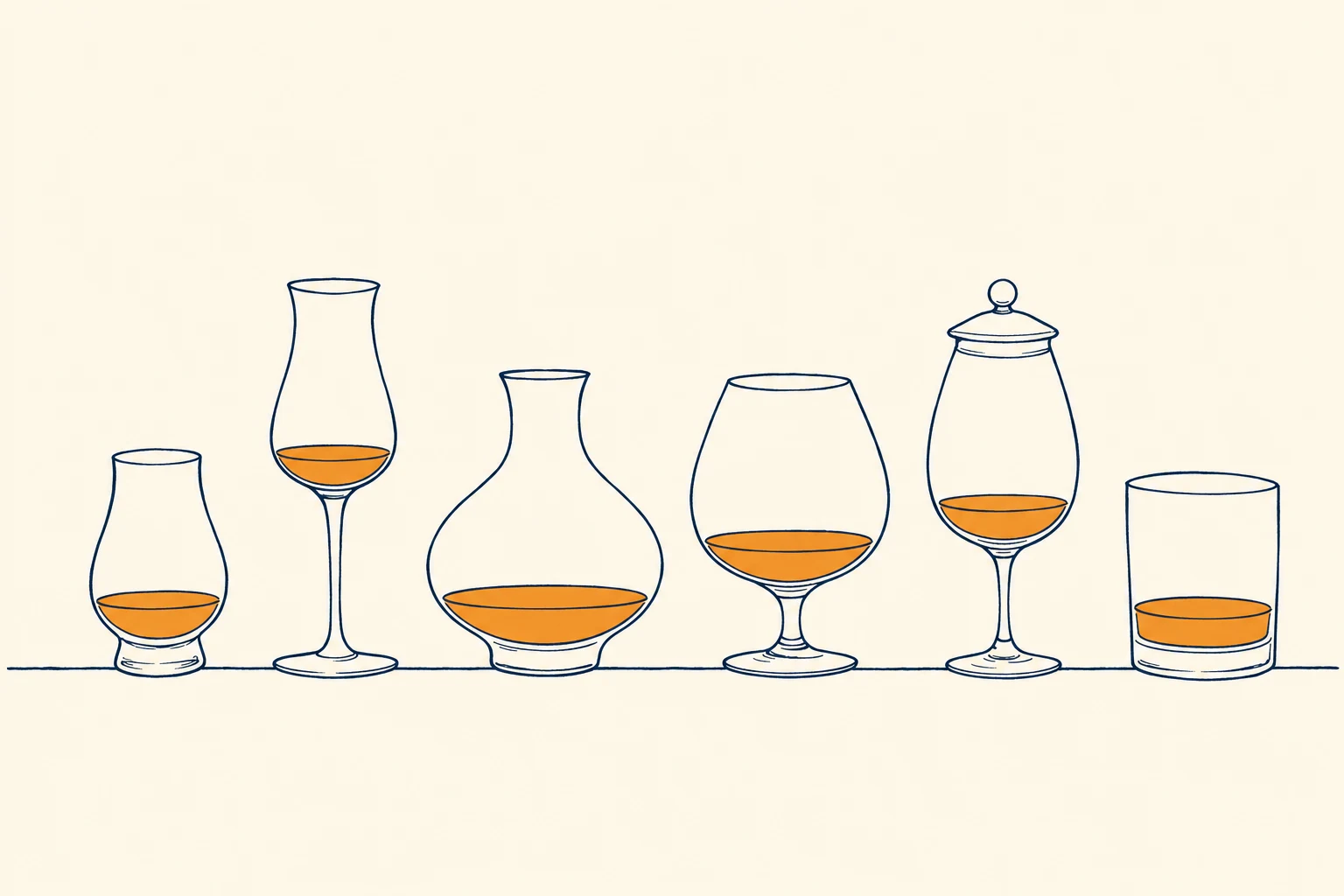
Rum glasses compared honestly: nosing glass, Glencairn, 1920s Blenders & Riedel – distilled from 227 community posts, with measurements and practical tips.
Read more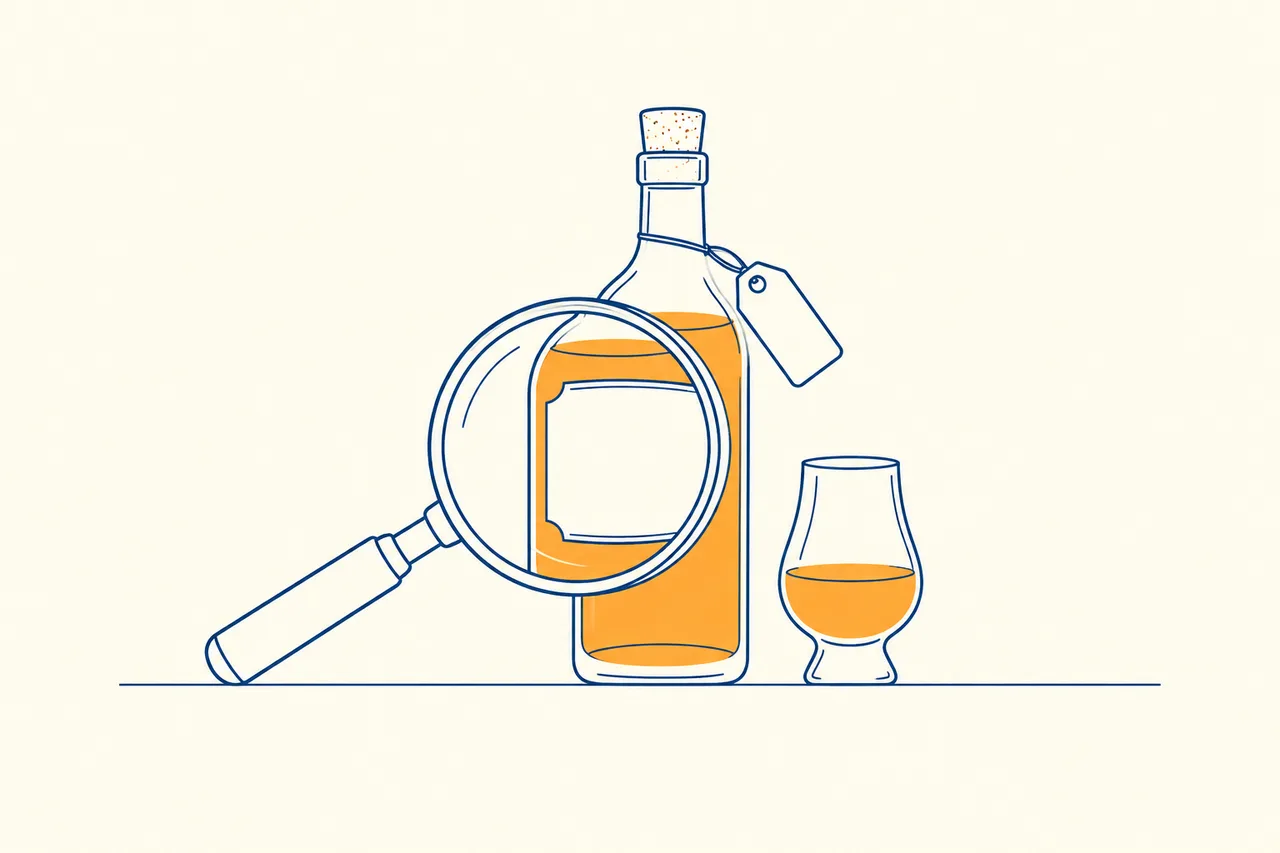
How do you recognise a good rum, and what does it cost? Seven criteria to check on the label, plus RumX community scores for each price band.
Read more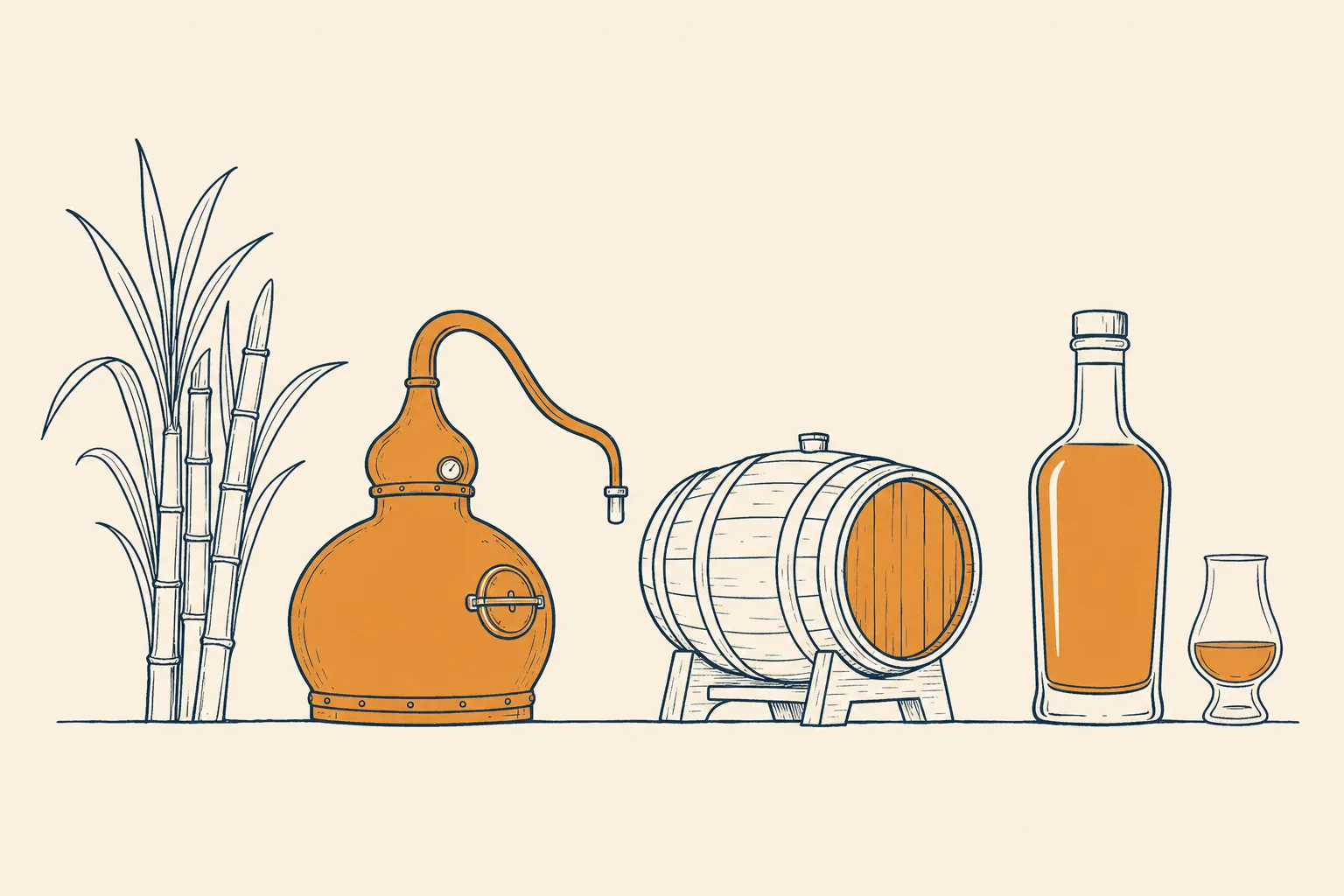
Rum is a spirit made from molasses, sugarcane syrup or sugarcane juice, bottled at 37.5% ABV or more in the EU. How it is made, and how it differs from rhum agricole, cachaça and rum-based spirit drinks.
Read more